A Simple Laundry Routine: 15 Steps Cut Down to 3
Most people think laundry is a motivation problem. It isn’t. It’s a system problem.
I counted every step in my laundry routine one day. There were fifteen. Not fifteen minutes — fifteen separate times I picked something up, carried it somewhere, and put it down again.
It’s three now. Same machine, same clothes, same amount of washing. None of it required more discipline than I had before.
I spent more than twenty years in lean manufacturing, taking steps like that out of factories for a living. It had never once occurred to me to look at my own house.
Why does a laundry routine feel harder than it is?
A laundry routine feels hard because most of it produces nothing. Carrying, sorting, piling and re-handling aren’t washing — they’re movement between the parts that are. In a factory that movement has a name: waste. Remove it and the job gets easier without anyone working harder.
The washing machine does the washing. The sun or the air does the drying. Everything a person does in between is transport and handling, and almost all of it is optional.
That’s why laundry resists effort. You can be more organised about carrying a basket down a hallway, but you’re still carrying a basket down a hallway. The only real fix is for the hallway trip to stop existing.
When I counted my own, eleven of the fifteen steps turned out to be movement. Four were the actual job.
What is point of use, and how does it work at home?
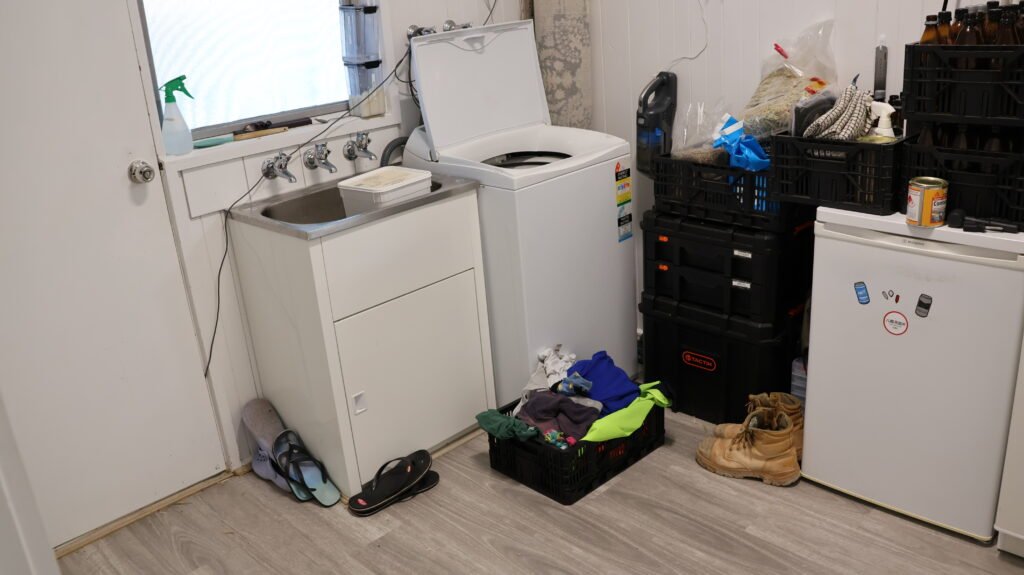
Point of use is a lean manufacturing rule: you put the tool where the work happens, not where there’s space in the cupboard. Applied at home, it means the washing machine belongs where clothes come off — not in a room down the hall. Moving one appliance removed six steps from my routine.
In a factory, you don’t walk a part across the building to the machine that works on it. You put the machine next to where the part is made. Do it the other way round and every single part carries that walk with it, forever.
My clothes were carrying the walk. Bedroom floor, into a basket, down the hallway, into the laundry, sorted, loaded — six steps before the machine had done anything at all.
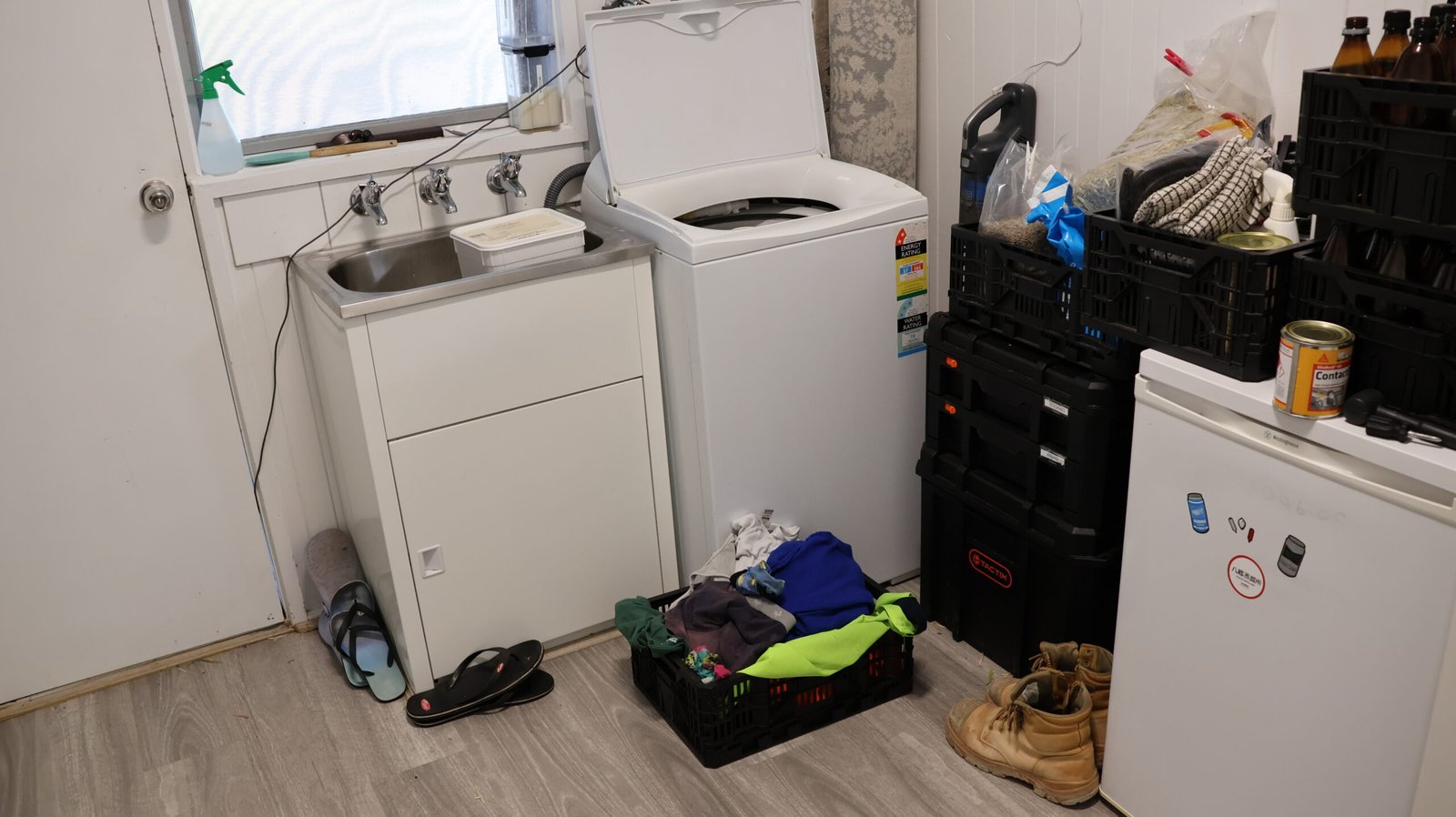
My machine now sits outside the bathroom door. Clothes come off and go straight in. That’s the step. The machine is the basket: it’s already there, it’s already open, and when it’s full it runs. There’s no pile to sort because the pile never forms.
Not everyone can move a washing machine, and it would be dishonest to pretend otherwise. If yours is at the other end of the house, the principle still works — it just looks different. Put the bin where the clothes come off, not where the machine is. Proximity is the point, not my floor plan.
One basket survived. It’s small, and it only holds what can’t go in a normal load: woollens, a colour I don’t trust yet, whites when there are enough to be worth it. Every system needs somewhere for the exceptions to go. Without one, the exceptions take over and you end up sorting every load because of three jumpers.
What were the fifteen steps, and what replaced them?
Here is the whole routine, before and after. Three steps survived. Eleven were removed by moving something rather than by trying harder, and one — waiting for the cycle — was moved to a time I wasn’t using.
| # | The old step | What happened to it |
| 1 | Clothes onto the bedroom floor | Gone — they go straight into the machine |
| 2 | Into a bedroom basket | Gone — there are no baskets in the house |
| 3 | Carry the basket to the laundry | Gone — the machine is at the bathroom |
| 4 | Sort into colours | Gone — one small basket holds the exceptions |
| 5 | Load the machine | Kept — step 1 of 3 |
| 6 | Wait for the cycle | Moved — it runs overnight |
| 7 | Unload into a basket | Gone — the airer comes to the machine |
| 8 | Carry the basket outside | Gone — the airer is on wheels |
| 9 | Hang the washing | Kept — step 2 of 3 |
| 10 | Unpeg into a basket | Gone — the airer moves, the clothes don’t |
| 11 | Carry the basket inside | Gone |
| 12 | Dump it on the bed | Gone |
| 13 | Fold | Kept — step 3 of 3, done in the room it belongs to |
| 14 | Carry piles to four rooms | Gone — the airer goes to the room |
| 15 | Put away | Gone — folding and putting away are now one move |
Washing at night is the cheapest change on the list. The machine finishes while I’m asleep, it goes onto the airer first thing, and by the time I’ve had breakfast it’s been drying for an hour. That hour costs nothing and I didn’t have to be awake for it. What’s left in the morning takes four minutes.
How do you dry clothes without a dryer?
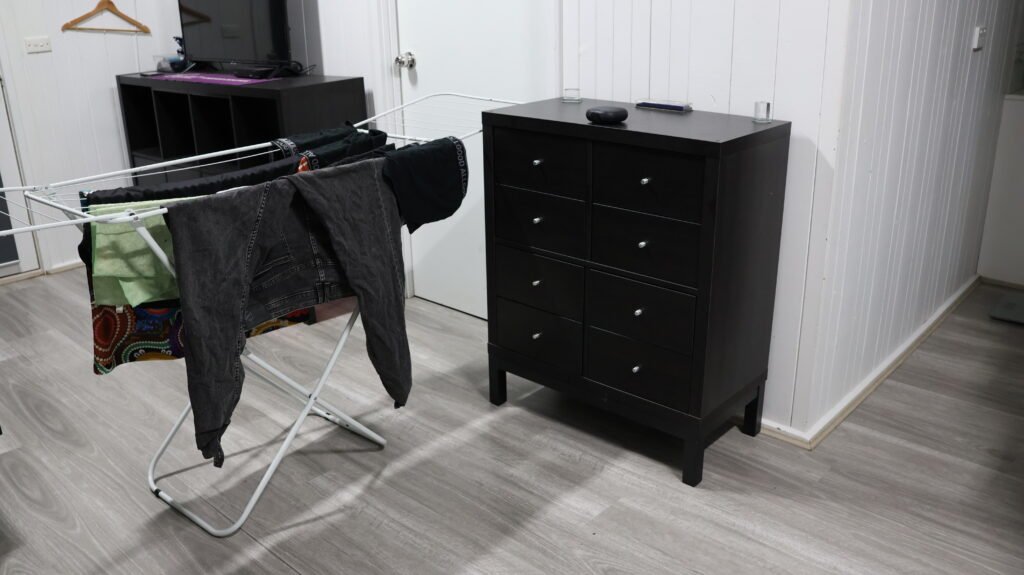
You dry clothes without a dryer by making the drying rack mobile and never letting wet washing wait in a container. The machine empties straight onto an airer standing beside it. The airer then follows the sun through the day and comes inside if it rains. No line, no basket, no second handling.
The old way was to pull the wet clothes into a basket, carry the basket outside, hang them one at a time out of the basket, then come back later and reverse the whole thing. That’s two extra handlings of every single item in the load — not two extra steps in the process, two extra handlings of every sock.
Now the airer comes to the machine. Door open, one item, straight on. When the machine’s empty the airer’s full, and it wheels out.
Two things sit inside that. Work shirts never touch the airer — they go from the machine straight onto a coat hanger, wet, dry in the shape they’re meant to be, and the hanger goes into the wardrobe. Folding is removed from shirts entirely, and ironing goes with it. Socks and underwear go on one peg hanger rather than spread across the rack. It takes the space of a single shirt, and when it’s dry the whole lot comes down together. Small items don’t need more space; they need grouping.
Because the airer has wheels, the weather stopped being a decision. It starts out the front in the morning sun and moves round the back in the afternoon. If it rains it comes inside and keeps drying in the lounge room. I don’t check the forecast before putting a wash on any more.
Does putting clothes away have to be a separate job?
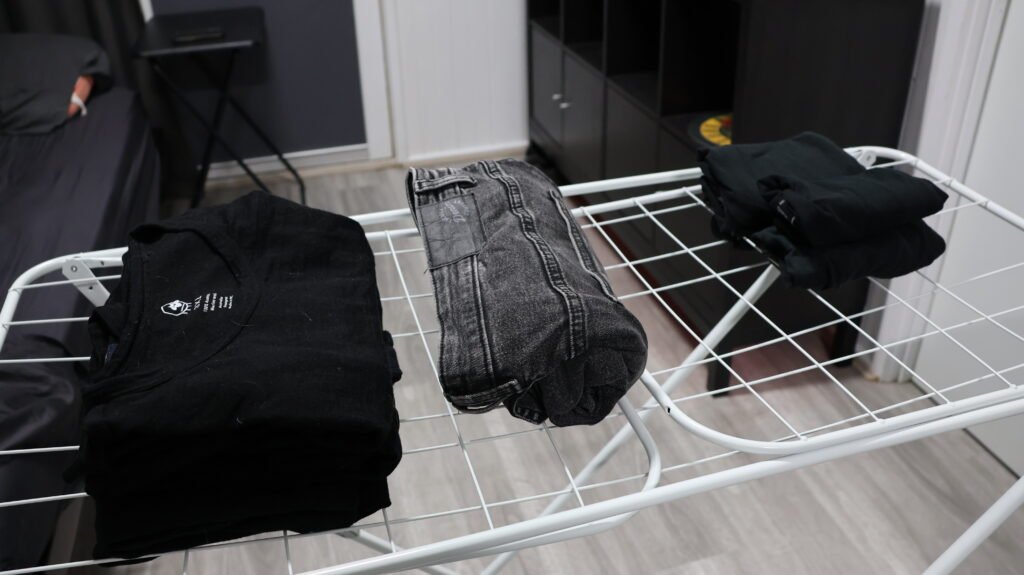
No. Putting away is only a separate job when clothes are folded somewhere other than where they live. Move the drying rack to the room instead of carrying piles out of it, and folding and putting away become one action. Towels don’t even need that — they go straight back onto the rail they came off.
Towels are the clearest version. They go in the machine at night and back on the bathroom rail in the morning. Hung flat, they’re dry by the afternoon, and they’re already exactly where you need them. No folding, no linen cupboard, no restocking. There are spares if something goes wrong; most weeks they don’t get touched.
For everything else, the airer goes to the room. And the part I didn’t plan: the airer is the folding table. It’s already standing there, the clothes are already on it. Take an item off, fold it on the top rail, straight into the drawer. The bed stays made. The couch stays clear. There’s no mountain of clean washing sitting there until nine at night.
What does it cost to run?
Almost nothing beyond the airer and a peg hanger. The ongoing cost is detergent, and I make my own. A couple of litres of the branded product is around forty dollars. Mine works out at a few cents a wash, and ten minutes makes a batch that lasts months.
It isn’t a sacrifice — the clothes come out the same. It’s the one part of the routine where the saving is money rather than time, and it’s the easiest single change on this page to try tomorrow.
What this routine doesn’t fix
Two honest limits, because a system that only works in one house isn’t a system.
It doesn’t work if the drawers are already full. Deciding where things go is the easy half. Making room for them is the harder problem, and if that’s where you are, I’d fix that one first. No amount of folding in the right room helps when there’s nowhere to put the folded thing.
It assumes you can put the machine somewhere sensible. If you rent, or the plumbing is where the plumbing is, the specific layout here won’t transfer. The principle does — shorten the distance between where clothes come off and where they get washed, by whatever means you have.
Everything else on this page is a subtraction, and subtractions transfer better than additions. You’re not being asked to buy a system. You’re being asked to look at what you already do and count it.
Frequently asked questions
How many steps should a laundry routine have?
Three is achievable in most homes: into the machine, onto the drying rack, into the wardrobe. Towels can be done in two. The number matters less than knowing what yours currently is — most people have never counted, and the count is what makes the waste visible.
Do you need a special drying rack?
No, but wheels change more than anything else you could buy. A rack that moves lets you follow the sun, escape rain without rewashing a load, and fold in the room the clothes belong to. A fixed rack forces the clothes to come to you instead.
Does washing at night actually save time?
It doesn’t make the machine faster. It moves the waiting to hours you weren’t using, so the washing is finished when you wake up and there’s an hour of drying done before breakfast. The only morning task left is hanging it, which takes about four minutes.
What is point of use in 5S?
Point of use is the principle of storing a tool or material where the work actually happens, rather than in centralised storage. It’s part of the “set in order” stage of 5S. At home it’s the reason a washing machine near the bathroom removes more steps than any organising system you could add.
Can this work if the laundry isn’t near the bathroom?
Yes, with an adjustment. The rule is proximity, not layout — put the collection point where clothes come off, even if the machine can’t move. A bin in the bathroom that gets emptied straight into the machine removes the hallway carry, which is the expensive step.
Is air drying practical in winter?
It’s slower and it needs somewhere indoors, but the mobile rack is what makes it work — the airer comes inside overnight into a warm room or out of the living space. Washing at night helps here too, since the load gets a head start before the day begins.
Home Decluttering Tips Using the 5S Method
Author bio
Grounded Roamer is written by a lean manufacturing practitioner with 20+ years experience creating systems that make everyday life run with less friction. Based in Mildura, Victoria, Australia — documenting a quieter, more self-sufficient way of living, one small adjustment at a time.