
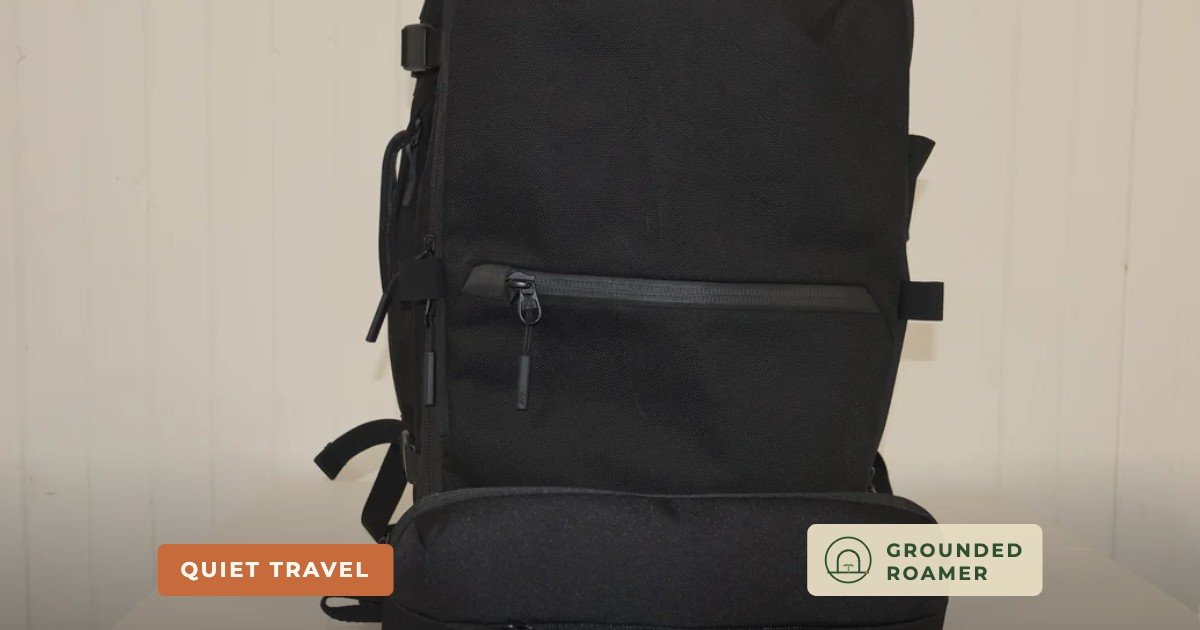
Japan Packing List: How I Packed One Bag for 15 Nights
Most Japan packing guides give you a list. This one gives you the system behind the list, and why that matters when you’re moving through seven places to stay across fifteen nights.
The trip: Tokyo hotels, two nights at an onsen, a family home in Mito, and stops through Niigata, Ibaraki and Tsukuba. Shinkansen, local trains, a hire car for a couple of days, and a lot of walking. One bag. No checked luggage.
What’s the system behind a one-bag Japan packing list?
Every item removes a friction point you know you’ll hit, and nothing goes in to cover a situation that probably won’t happen. For fifteen nights and seven places to stay, that came down to five layers: a front pouch, a sling bag, a toiletry kit, three shower cubes and a short list of clothes.
I’ve spent more than twenty years in lean manufacturing, and one thing that work teaches you quickly is that carrying too much is just as much of a problem as carrying too little. Every extra item is a decision you have to manage on the road. So this isn’t about being a minimalist. It’s about knowing where the friction will be and solving it before you leave.
| Layer | What’s in it | What it solves |
|---|---|---|
| Front pouch | Tech tote (60 W charger, two short cables, slim battery bank), over-ear translation headphones, a pen, a padlock | Digging for things while you’re on the move |
| Sling bag | Camera and a small foldable shopping bag | A flexible daytime layer, without opening the main bag |
| Toiletry kit | Bar soap in an exfoliating bag and a Matador FlatPak case, deodorant stick, small toothbrush and toothpaste, Matador quick-dry towel | Liquids at security, leaks, mushy soap, and guessing what towels a place provides |
| Shower cubes | Three identical cubes: one merino t-shirt, two pairs of merino socks, two pairs of boxers | Opening three cubes looking for a sock |
| Clothes | Merino jumper, windbreaker, two pairs of jeans, shorts, one pair of shoes | Too many options to manage on the road |
What goes in the front pouch?
Everything I need while I’m moving. In a factory, you keep a tool where the work happens, not in a cupboard down the hall. The front pouch is that for travel: the easy-access layer for airports, stations and check-ins, so nothing that matters in transit is buried in the main bag.
The passport wallet lives on my body, not in the bag. Passport, some cash and two cards. Not all my cards, just two. If something goes wrong, I haven’t lost everything in one hit. A simple security split that costs nothing to set up.
Then a tech tote: a 60-watt charger, two short cables and a slim battery bank. Short cables only. Long ones tangle and take up space, and you’re rarely that far from a power point. Short ones do the same job in less room. Small decision, but it adds up over fifteen nights.
Headphones. My ears don’t get along with in-ear buds, so over-ear was always the call. My bigger noise-cancelling pair at home takes up too much space. These are a happy compromise: smaller, lighter, with AI translation built in. In a country where English isn’t always available, that’s a real tool, not just a nice feature.
A pen, because you still need one. And a padlock on the pouch in crowds, off when I need quick access at the airport, checking in or on a train platform. It’s not about paranoia. It’s about not having to think about it in busy places.
What’s the sling bag for?
The sling bag is the flexible daytime layer. It was a late addition to the plan, and it changed how the system works during the day. It carries the camera and a small foldable shopping bag. At the airport, where there isn’t much to photograph, it goes inside the main bag and the front pouch handles transit.
How do you pack toiletries for carry-on only?
Swap liquids for solids where you can. Bar soap goes through carry-on security without question: no liquids bag, no bottle sizes, nothing to leak. Mine sits in an exfoliating soap bag, so I don’t need a separate sponge or washer. The bag does that job. Then the whole thing goes into a Matador FlatPak soap case.
The case is the clever part. It’s made from a vapour-permeable material: waterproof from the outside, but moisture escapes as vapour from the inside. Put a wet bar of soap in after a shower, roll it closed like a dry bag, clip it and pack it away. The soap dries through the fabric. No mush, no mildew, nothing wet in the bag. Three items, three problems solved.
A deodorant stick, a small toothbrush with a cover and a small toothpaste round it out, all in a small tote. Nothing loose, nothing rolling around. And a Matador quick-dry towel that packs down small. Staying at a family home and an onsen, I didn’t want to assume what would be provided. Bringing my own takes that question off the table.
What is the shower cube system?
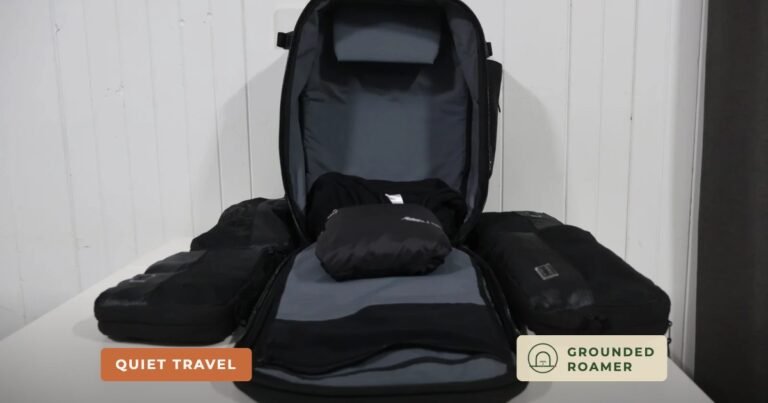
Three identical packing cubes, each holding one complete change of clothes: one merino t-shirt, two pairs of merino socks and two pairs of boxers. When it’s time to shower, I grab one cube and the toiletry bag. That’s it. Everything for a shower and a change of clothes is already together.
In manufacturing, this is called kitting. Everything for one job is grouped into a single kit, so nobody goes hunting for parts halfway through the task. The shower cube is a kit. Whether I’m in a Tokyo hotel, at the onsen or in a family bathroom in Mito, it works the same way. I’m not opening three cubes looking for a sock. I’m not digging through the main compartment.
Fifteen nights. Seven places. The same system every time. That’s the whole point.
Merino earns its place here. It handles a few nights between washes, it doesn’t hold odour the way cotton does, and it dries quickly. On a trip where you’re always moving, that matters more than a different shirt every day.
What clothes do you need for 15 nights in Japan?
Fewer than you’d think, if each piece has a job. Mine were a merino jumper, a windbreaker, two pairs of jeans, a pair of shorts and one pair of shoes, with the three shower cubes covering everything underneath. Each choice came down to one question: will I actually wear it?
The jacket earns its place twice. It’s cold leaving Mildura and Melbourne in the morning, and once I warm up it tucks into the top of the bag. But the real reason it’s my main outer layer is the pockets. Tapping a transit card in and out, lining up for a baseball game, walking through a shrine: you need your hands free and your essentials within reach. The jacket pockets are that system.
Two pairs of jeans, one worn travelling and one in the bag. I did think about trackies. They’re comfortable and pack down small. But I know myself. I’d wear them in the hotel and that’s it. I’m not a trackies-in-public kind of person, so the second pair of jeans made more sense. A pair of shorts covers hotel and comfort days.
One pair of shoes. Temples, markets, the gondola, day trips: a lot of walking across a lot of days, so comfort matters far more than options. And in Japan, where shoes come on and off at shrines and restaurants, one simple pair that works everywhere is easier than managing two.
What is the system really about?
When I look at this bag packed and ready, I don’t see a list of items. I see decisions that have already been made. I won’t be standing in a hotel bathroom wondering where my socks are. I won’t be digging through the main compartment at a train station. I won’t be pulling out liquids at security.
It’s the same thinking I use at home. The same reason I reset the kitchen on a Sunday, set up zones in a cupboard, or think about where things live before I need them. It’s not about having less. It’s about a system that runs itself, so when life moves fast, you’re thinking about where you are, not what’s in your bag.
If you want the whole thing on one page, the free Japan packing checklist has every item and the reason it’s there. And if you want to see where this started, here’s the pack I chose before the trip.
What’s the one thing you always end up overpacking?
Frequently asked questions
Does one bag really work for 15 nights in Japan?
With the right system, yes. Merino handles the clothing rotation, compression cubes keep things organised, and bar soap keeps the toiletries carry-on safe. Japan’s trains also reward light packing. A carry-on sized bag is much easier to manage on the Shinkansen and through busy stations.
What is the Matador FlatPak soap case?
A travel soap case made from vapour-permeable, waterproof material. It keeps liquid water in but lets moisture escape as vapour, so a wet bar of soap dries inside the case without getting anything else wet.
Grounded Roamer is written by a lean manufacturing practitioner with 20+ years experience creating systems that make everyday life run with less friction. Based in Mildura, Victoria, Australia — documenting a quieter, more self-sufficient way of living, one small adjustment at a time.
One Comment