The Domino Reset: I Moved One Thing and Four Areas Got Easier
I changed one small thing in my house, and it set off a domino effect.
It wasn’t a makeover, and it definitely wasn’t a “new me” moment. Just a few practical changes that made the place easier to live in. None of it was expensive, and none of it was complicated. It was mostly moving things to where they actually belong.
Why does one small change lead to another?
Because freeing up one space gives you options somewhere else. When something doesn’t have a home, it doesn’t just sit there. It turns into a little pile, and piles create mental noise. Give one thing a proper home and the space it used to take becomes the answer to the next problem. That’s the domino.
I notice those piles every time I walk past, every time I try to clean, and especially when I’m tired and want the house to feel easy, not like another job. I’m not chasing perfection. I just want less friction.
Here’s how the whole chain ran.
| Domino | What changed | What it freed up |
|---|---|---|
| 1. Under the futon | Cheap drawers for my clothes | Two cubes in the TV cabinet |
| 2. TV cabinet | Display pieces moved into the freed cubes | The two-cube unit under my D&D poster |
| 3. Under the poster | The cube unit moved out | Empty space, and somewhere to put things while I sort them |
| 4. Laundry | The cube became a gear station, with crates for loose tools | Bulk cooking gear moved into kitchen cupboards that had room |
| 5. Outside | A big shelf for the BBQ and garden crates | No more unstacking to reach the bottom crate |
Where did the domino reset start?
Under the futon. I grabbed some cheap drawers to go under it, and that kicked the whole thing off. I didn’t buy furniture. I bought space. That spot was doing nothing, and using it for clothes means they’re right where I get changed, tucked away instead of ending up over the chair or on the floor.

What I like about it is that it feels natural. It’s not a perfect system, just one I can keep up with. If putting things away takes effort, I won’t do it every time. But if the spot is right there and it’s easy, it actually happens.
What happened when the TV cabinet had room?
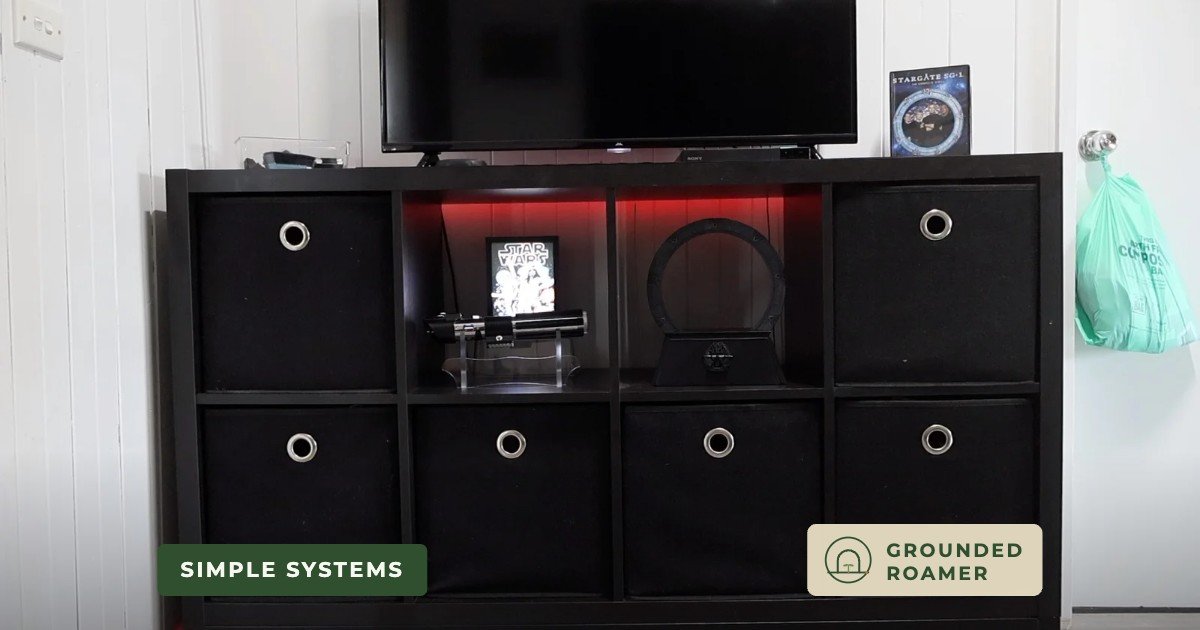
It stopped feeling cramped. Moving the clothes freed up two cubes in the TV cabinet, and I moved my display pieces into that space. I like seeing them. They make me happy. It still feels like my place, but it’s contained, not clutter, and the cabinet just does its job without everything jammed in.

That’s the difference for me. I don’t need a minimalist house. I need a house that doesn’t demand attention. When storage is crammed full, the room always feels like it wants something from you. When there’s a bit of slack, it stays calmer for longer.
Why is empty space useful?
It’s a buffer. Once the display pieces moved, I could shift the two-cube unit that sat under my D&D poster, and the best upgrade turned out to be the empty space it left behind. It’s easier to clean, easier to walk past, and the room feels bigger without changing anything major.
It also gives me spare capacity. If something comes into the house, I’ve got somewhere to put it while I sort it properly, instead of it landing on top of something else. In manufacturing, that’s exactly what a buffer is: a bit of spare room so one hiccup doesn’t stop the whole line. We’re so used to filling every gap, but less isn’t a sacrifice. It’s space that works.
How did the laundry become a gear station?
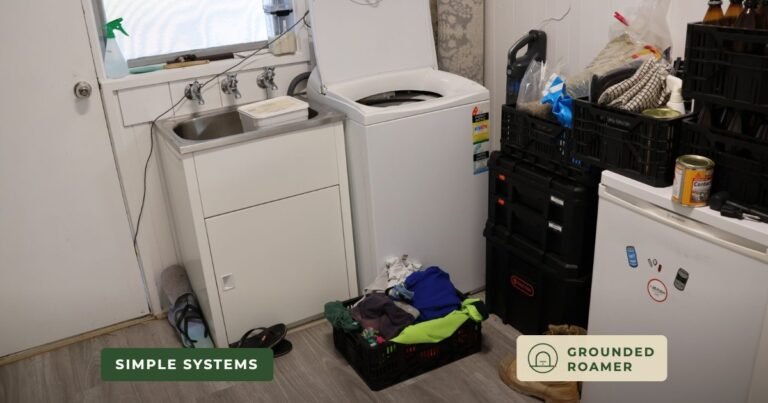
The freed-up cube went into the laundry and gave that area a proper purpose. That’s when things started feeling properly organised. The home brew gear and bottles got a dedicated spot. The bulk cooking gear moved into kitchen cupboards that already had room. And the random tools that used to end up in corners, or overflowing onto shelves, went into crates that stack neatly.

That’s the kind of storage I actually keep up with. Visible enough that I remember what I’ve got, but contained so it doesn’t look messy.
It’s also the idea that keeps saving me: containment beats perfection. If something has a container, it usually stays tidy. If it doesn’t, it turns into a pile, even if I mean well. It doesn’t need to be fancy. A drawer, a cube, a crate, anything with edges. Edges set a limit. They show you where things go, and where they stop.
What was the last domino?
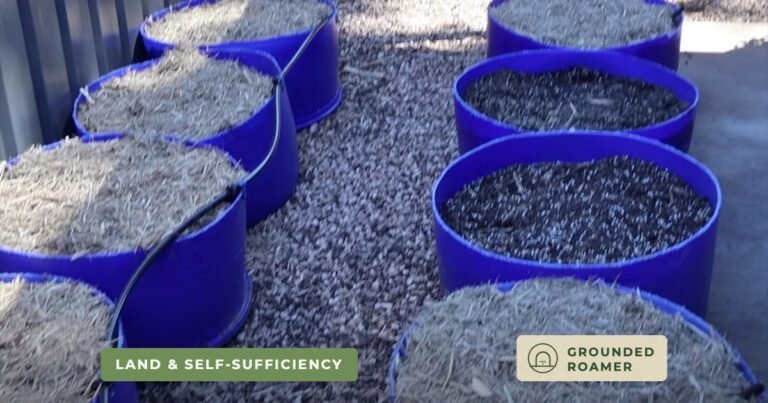
Moving a big shelf outside for my BBQ and gardening crates. Before that, everything was stacked. If I needed the bottom crate, I had to unstack half the pile, grab what I wanted, then stack it all back up. That last part didn’t always happen, so the crates would end up sitting around everywhere.
With the shelf, each crate has its own spot. It’s easier to grab what I need and easier to put it straight back, so the area stays tidy without me thinking about it.
What are the three rules behind it?
Keep things near where they’re used, give everything a container, and let space pay rent. They’re simple enough that I can actually stick to them, and that matters more than a better-looking system that doesn’t last.

Rule one: keep things near where they’re used. If I have to walk to another room to put something away, it won’t happen every time. Rule two: give everything a container. Drawer, cube, crate, tub, it doesn’t matter. If it’s contained, it’s easier to keep tidy. Rule three: let space pay rent. Empty space isn’t wasted. It’s a buffer that stops the whole system falling over the second life gets busy.
They’re the same ideas behind 5S at home, and I’ve added to them since in my simple organising rules.
What do I want from the house?
For it to support me in the background, not demand constant attention. This isn’t about a nicer-looking house. It’s about an easier system, with small changes I notice every day: when I wake up, when I clean, and especially when I’m tired. My test now is simple. Can I reset the room in two minutes when I’m tired? Since these changes, it’s way easier.
Not perfect. Just practical, easy to maintain, and working properly.
What turns into piles at your place: clothes, tools or paperwork?
Grounded Roamer is written by a lean manufacturing practitioner with 20+ years experience creating systems that make everyday life run with less friction. Based in Mildura, Victoria, Australia — documenting a quieter, more self-sufficient way of living, one small adjustment at a time.
2 Comments