Small Space Living: Why My House Looks Empty on Purpose
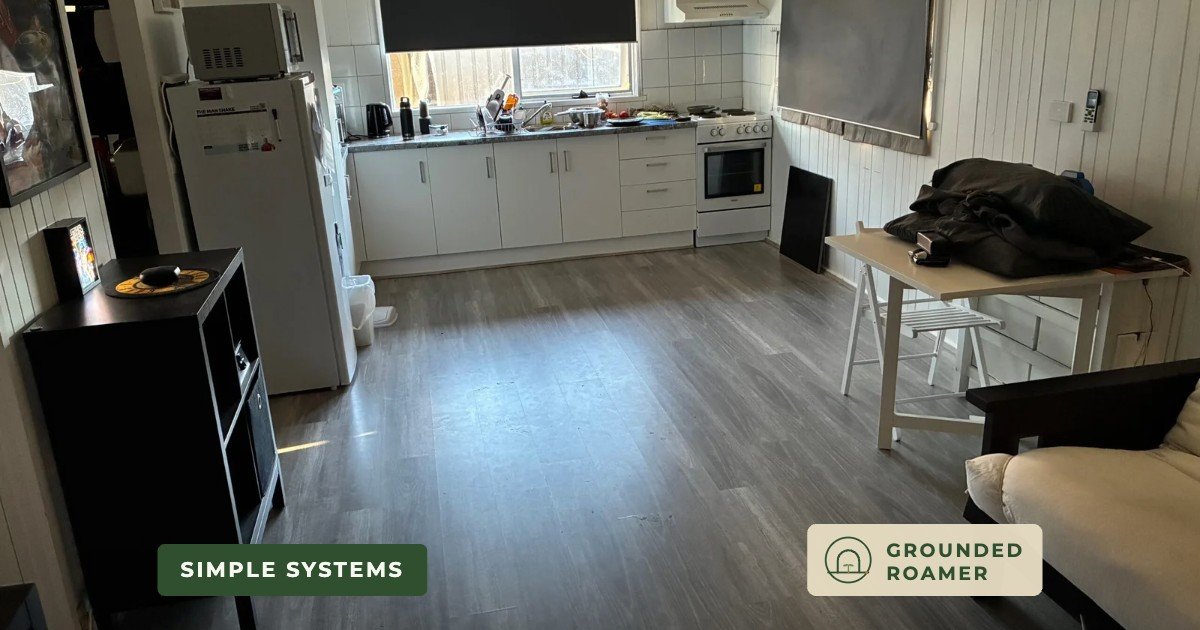
When people come to my place, the first thing they usually ask is “Where do you sleep?” Not long after that, they usually say how spacious it feels.
That probably sounds strange for a small one-bedroom unit, but that’s the whole point of how I’ve set it up. It’s simple, compact, and it works for the way I live. I’m usually only home from Thursday evening to Monday morning, because I’m away on site during the week. I also have my kids most weekends, so the place needs to work for me on my own and still feel like home for them.
Why does a small one-bedroom unit feel spacious?
Because there isn’t much in it. I don’t own a lot of things, so I don’t have a lot of clutter. Less furniture means more room to move, less visual noise and less stuff to manage. The place is easier to clean, easier to reset and easier to live in. It’s not styled for show. This is just how I keep it.
The only time it looks a bit more lived in is when the kids are here, which is exactly how it should be.
Why do the kids get the only bedroom?
So they feel like they have a place in this home, not like they’re just visiting for the weekend. It’s only a one-bedroom unit, and the bedroom belongs to my kids when they’re here. That matters to me. It also means I sleep in the lounge, which a lot of people wouldn’t choose, but it works for me.
Is sleeping on a futon every night worth it?
For me, yes. My futon folds out each night and packs away in the morning. It takes about three or four minutes to make the bed, and in return I get my living space back for the whole day. The bedding lives in the top of the kids’ wardrobe, so it’s out of the way when it’s not in use. That trade is worth it every time.
What surprised me most is how good a futon is to sleep on. A couple of years ago I went to Japan and slept on futons there, and my back felt better than it had in a long time. That’s what made me look into getting one properly when I came home. I sleep well on it, and I don’t wake up sore.
A lot of people wouldn’t want to pack up their bed every day, and I get that. But having open space through the day matters more to me than the small effort of folding it away. It changes how the whole place feels. It also saves me paying for an extra room I don’t need. A few minutes of setup, in exchange for more space, less rent, and a layout that works better the rest of the time.
What furniture works best in a small space?
Furniture that does more than one job. That’s a big part of why this unit works. I don’t want more pieces, just better ones. Here’s how the main pieces earn their place.
| Piece | The jobs it does |
|---|---|
| The lounge room | Living room by day, my bedroom at night |
| The futon | A bed at night, packed away in the morning |
| The collapsible table | Coffee table, bedside table, side table and drop spot |
| The folding table | Games and Lego with the kids, meal prep and extra bench space; folded away, it leaves room to dry clothes |
| The bedroom | The kids’ room, so it’s theirs whenever they’re here |
The little collapsible table beside the lounge is one of the best examples. It’s been so useful I’m thinking about getting another one. The folding table is probably my favourite piece in the whole place. It stays out when I need it and folds away quickly when I don’t. When the kids are here, we use it for games, Lego and whatever else we’re doing. On my own, I move it into the kitchen for meal prep or extra bench space.

When it’s folded away, I get that room back. The space becomes useful for drying clothes, moving around more easily, or just keeping the place feeling open.
Why do I still keep DVDs?
Because I own them. I got tired of streaming services constantly changing what was available, and even when you pay for something digitally, it doesn’t really feel like it’s yours. DVDs are simple. I know what I’ve got, I can watch it when I want, and I’m not relying on subscriptions or the internet. A lot of what I watch is older stuff anyway, especially 80s shows. It’s familiar, easy to throw on, and it helps me switch off at the end of the week.
How do you keep a small place tidy?
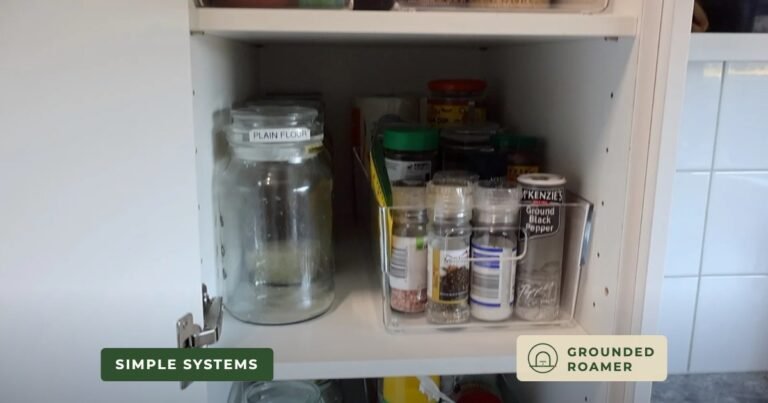
Give everything a home. That’s probably the biggest rule in this house, and it applies in the kitchen, the drawers, the storage tubs and pretty much everywhere else. If something has a place to go, the house stays tidy without a big reset all the time.
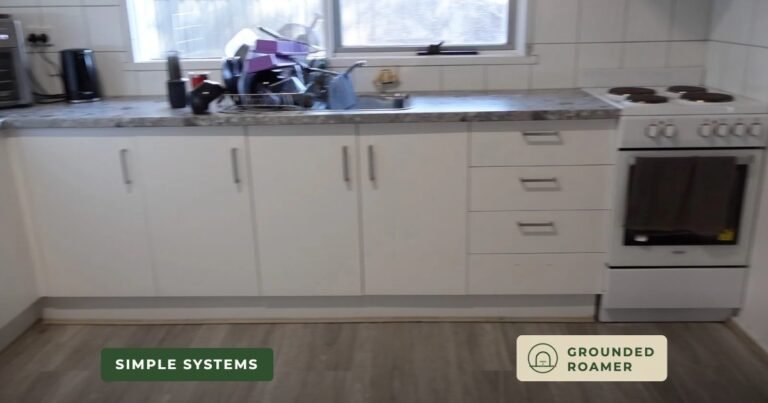
The kitchen is small, but it works because everything is laid out where it belongs. I’ve written more about how the kitchen is set up. Same with the cupboards, and the tubs in the storage area. Things don’t build up as quickly, so the clean before I head back to work is straightforward: dishes, sweep, vacuum, mop, done.
What about the messy part of the house?
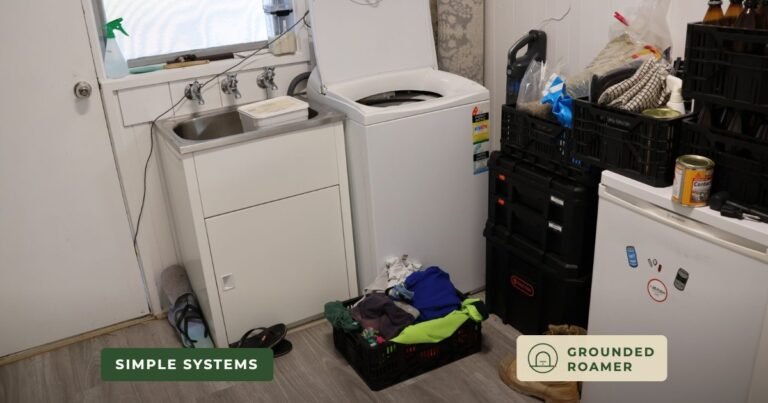
It’s still real life. The washing machine area, camping gear, work gear, home brew equipment, freezer, brewing fridge, tools, first aid kit and all the extra odds and ends still need to live somewhere. That side of the house isn’t as neat as the main room, but I keep things grouped into tubs and categories so it stays usable.

It’s not perfect, but it works. And that’s really the point of the whole place. I’m not trying to make it look like a display home. I’m trying to make it easy to live in.
What would I still improve?
A few jobs, none of them urgent. I’d like to add some drawers so a few things can be stored more cleanly and out of sight. I want some lighting for the display shelf. And I wanted better storage for clothes and a few loose items that didn’t have a good setup yet.
That last one has since been sorted. Cheap drawers under the futon fixed the clothes, and that one change rolled through the rest of the house. That’s the domino reset, and the rules I took from it are in my simple organising rules.
Why does this setup suit me?
This place isn’t big, but it doesn’t need to be. It gives me what I need. It works for my routine. It works for the kids. It’s easy to maintain, and it feels calm when I’m home. That matters more to me now than having extra rooms full of things I don’t use.
For a lot of people, this setup probably wouldn’t suit them. For me, it does. And that’s enough.
Would you trade a few minutes each morning to get your living space back?
Grounded Roamer is written by a lean manufacturing practitioner with 20+ years experience creating systems that make everyday life run with less friction. Based in Mildura, Victoria, Australia — documenting a quieter, more self-sufficient way of living, one small adjustment at a time.