
Cut your laundry from fifteen stops to three — one small change at a time.
A laundry system is the path clothes take from the floor to the drawer. Ours used to have fifteen stops in it. It now has three, in the same house, with the same machine, washing the same amount.
This is the free guide to how that happened. Sixteen small changes, each on one page, each one small enough to try today. You are not meant to do all sixteen. You are meant to do one, live with it for a week, and see whether it stays.
Get the free guide
Put your email in and I’ll send you Volume One.
Free · PDF · A4 · 29 pages · Three printable recipe cards
The download opens straight away. Confirm your email and a copy of the link follows, then a monthly letter. Unsubscribe any time.
Last updated: September 2026
How do you stop laundry piling up?
You remove the places it is allowed to pile. Not by working faster.
Every basket, every pile, every “I’ll deal with that later” surface is a waiting place — somewhere the job is allowed to pause. A paused job has to be restarted, and restarting is where the effort actually lives. Nobody minds hanging washing. Everybody minds the pile on the bed that has been there since Tuesday.
Which means the pile is not a discipline problem. It is a design problem, and it has a physical cause you can point at: there is a flat surface in your house whose job is to hold clothes that are between places. Take that surface out of the route and the pile has nowhere to form.
That is what most of the sixteen changes below do. They do not add a habit. They remove a waiting place — the list names what each one takes out, so you can see it. Get rid of the baskets and there are three fewer places clothes can wait. Fold on the rack instead of the bed and the bed stops being a staging area. Empty the machine straight onto the rack and the wet pile never exists.
You will notice none of that requires you to be a tidier person than you are now.
Is it better to do one load a day, or one big laundry day?
Smaller and more often, and the reason is probably not the one you have read elsewhere.
The usual argument for a load a day is that it stops the backlog building. True, and fine. But the reason it matters here is physical: our drying rack has to be light enough to pick up and carry, because it follows the sun across the yard and comes in when it rains. A full weekly wash makes a rack nobody wants to lift, and a rack nobody wants to lift stays where it is, in the shade, still damp at five o’clock.
So the load size is set by what you can carry, not by what the machine can hold. That is change 10, and it only makes sense once you see it alongside changes 11 and 12.
The honest trade-off: more loads means more starts and stops, and if your machine is in an awkward spot that is genuinely worse, not better. Which is why change 15 exists, and why it is last.
How do you dry clothes without a dryer?
You move the clothes to the weather rather than waiting for the weather to cooperate.
Two changes cover this, and they are the two most people underestimate. The first is following the sun — the rack does not live in one spot, it gets moved two or three times a day to wherever the sun currently is. That sounds like more work than it is. It is about fifteen seconds each time, and it is the difference between dry by three and damp overnight.
The second is bringing it in when it rains, which needs the rack to be somewhere you can reach in under a minute, and light enough to move in one trip. A load that gets rained on gets rewashed, and a rewash costs more than every trip out to the rack combined.
What makes both of these work is that the rack is small and light. Not a fixed line, not a big rack you have to dismantle. Something one person carries with wet washing already on it.
How many stops should doing the laundry take?
Fewer than it takes now, and the number is worth counting once.
Walk the job with a pen. Every place a piece of clothing stops — the floor, the basket, the second basket, the machine, the rack, the bed, the pile, the drawer — is a stop. Most houses run somewhere between twelve and twenty. Ours was fifteen.
Three is achievable in a normal house without building anything. The clothes come off and go into the machine. The machine empties onto the rack. The rack comes in and the clothes go where they live. That is it, and nothing in that sequence needs money.
Counting is worth doing once because it turns a vague feeling into a number, and a number is something you can watch go down.
The method: one change at a time
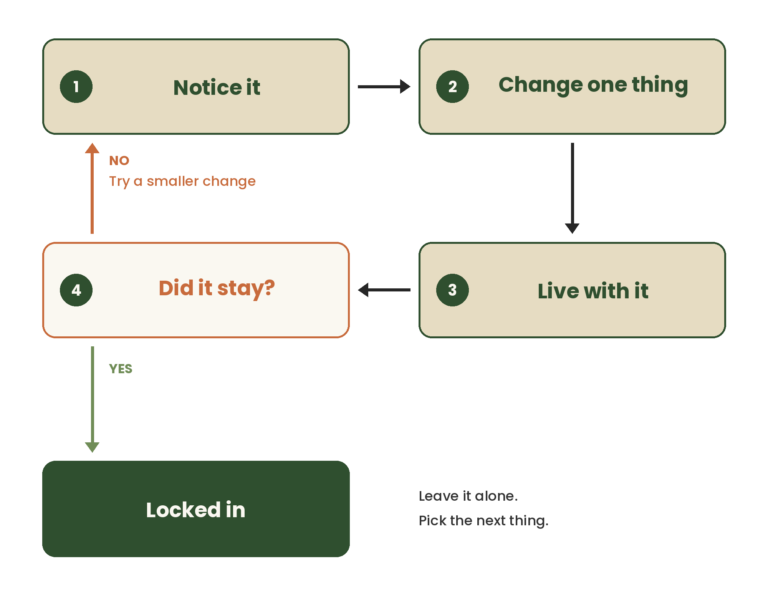
There is no plan in this guide and no schedule. Four steps, run as many times as you want.
- Notice it. Where in the job do you sigh? That is your change.
- Change one thing. Today, and small. If it needs a weekend it is too big.
- Live with it. A week or two, until it stops feeling new.
- Did it stay? Slipped back — the change was too big, so try a smaller version of the same idea. Stayed, and it feels better — it is locked in. Leave it and pick the next thing.
The reason it is one at a time is that a habit you are holding on purpose is not finished. Four at once means four things to hold, and one bad week takes all four down. One at a time means a bad week costs you one change, and you already know how to get it back.
The sixteen changes
All sixteen, in full. Each one gets a page in the guide with the reason behind it, what it costs, what to watch for and room for a photo of your own.
They are not in order and they are not steps. Read the list, find the one that matches where you sigh, and start there.
|
# |
The change |
What it removes |
|
1 |
Run the wash overnight |
The morning job |
|
2 |
Hang shirts wet |
Folding shirts, and ironing them |
|
3 |
Towels straight back on the rail |
Folding towels, and the trip to the linen cupboard |
|
4 |
Fold in the room the clothes live in |
Carrying piles from room to room |
|
5 |
Fold on the rack, not the bed |
The pile on the bed |
|
6 |
All the socks on one hanger |
Pairing socks off the rack one at a time |
|
7 |
Keep one basket, for the odd stuff only |
Sorting every single load |
|
8 |
Empty the machine straight onto the rack |
Two handlings of every item |
|
9 |
Get rid of the laundry baskets |
Three places where clothes wait |
|
10 |
Wash more often, in smaller loads |
The rack being too heavy to move |
|
11 |
Follow the sun |
Guessing |
|
12 |
Bring it in when it rains |
Rewashing a whole load |
|
13 |
Put the drop point where clothes come off |
The walk down the hallway |
|
14 |
Put clothes straight into the machine |
The bin as well |
|
15 |
Move the machine |
The distance that was causing all of it |
|
16 |
Make your own laundry liquid |
About forty dollars a bottle |
Where to start, if you want a recommendation. Number 1 or number 3. Both take one evening, neither needs anyone else in the house to agree, and both give you the feeling of the method working, which is what carries you to the next one.
Where not to start. Number 15. Moving the machine is the change that removes the most, and it is also the one most likely to make you give up, because it needs a plumber, a decision and somebody else’s agreement. It is in the guide at number 15 for exactly that reason. Leave it until the easy ones have convinced you.
If you would rather see it done than build it, here is our actual week.
What is in the guide that is not on this page
The list above is the honest version of what the guide contains. What you get by downloading it is the working copy:
- A page for each change — why it works, what it costs, what to watch for, and space for a photo of your own house.
- The change log — one page, ruled, to write down what you tried and whether it stayed. The only paperwork in the book.
- The doorway check — a short page on standing in the room and looking at the job again, a few months on.
- Three recipe cards, printable:
- Card 1 — Laundry liquid. Replaces about forty dollars a bottle.
- Card 2 — Blood and protein stains.
- Card 3 — Wool and merino wash. Eucalyptus, and why the liquid on Card 1 must never go near woollens.
Get Volume One, free
Put your email in and I’ll send you the guide.
No course, no follow-up sequence you have to escape from. The guide opens straight away. Confirm your email and a copy follows, then a monthly letter. Unsubscribe any time.
What comes next
Volume Two is the kitchen. After that, bathroom and linen. Eventually all of them bind together as The Complete Grounded Home System, and if you have a volume already you will not be asked to buy it twice.
New volumes go to the email list first.
FAQ
How often should you do laundry?
More often than most advice suggests, if you are drying outside. We run a small load most days rather than a big one twice a week. Not for freshness reasons — because the drying rack has to stay light enough to pick up and carry into the sun, and a week’s washing makes a rack that stays where it is. If you have a dryer, this matters far less and you can ignore it.
How do I catch up when the laundry is already out of control?
Do not try to fix the system and the backlog at the same time. Clear the backlog however you like — a long weekend, a laundromat, one enormous day — and treat that as separate. Then start the first change on Monday with a normal week’s washing. Changing the route while you are three loads behind is how people conclude the method does not work.
Do I need a laundry room to have a laundry system?
No, and not having one can help. A separate laundry room is itself a stop — a room clothes go to wait in. The changes in Volume One are built for small houses, rentals and caravans, where the machine is wherever the plumbing allowed and moving walls is not an option.
What if a change does not stick?
Then it was too big. That is information, not failure. Try a smaller version of the same idea — if folding in the bedroom did not hold, fold on the rack instead. The loop is designed to expect this, which is why step four is a question and not a tick box.
Is the guide free, and what do I get?
Yes, free. A 29-page A4 PDF: one page per change, a change log, the doorway check and three printable recipe cards.
Can I use homemade laundry liquid on wool?
No. Never on wool, and the guide is firm about this. The liquid on Card 1 is built on washing soda, which is strongly alkaline, and wool is keratin — the same protein as hair. Alkaline breaks protein fibres down, so the damage is permanent and it happens on the first wash. Card 3 is a separate eucalyptus wool wash — grated pure soap, methylated spirits and eucalyptus oil — and it explains the chemistry.